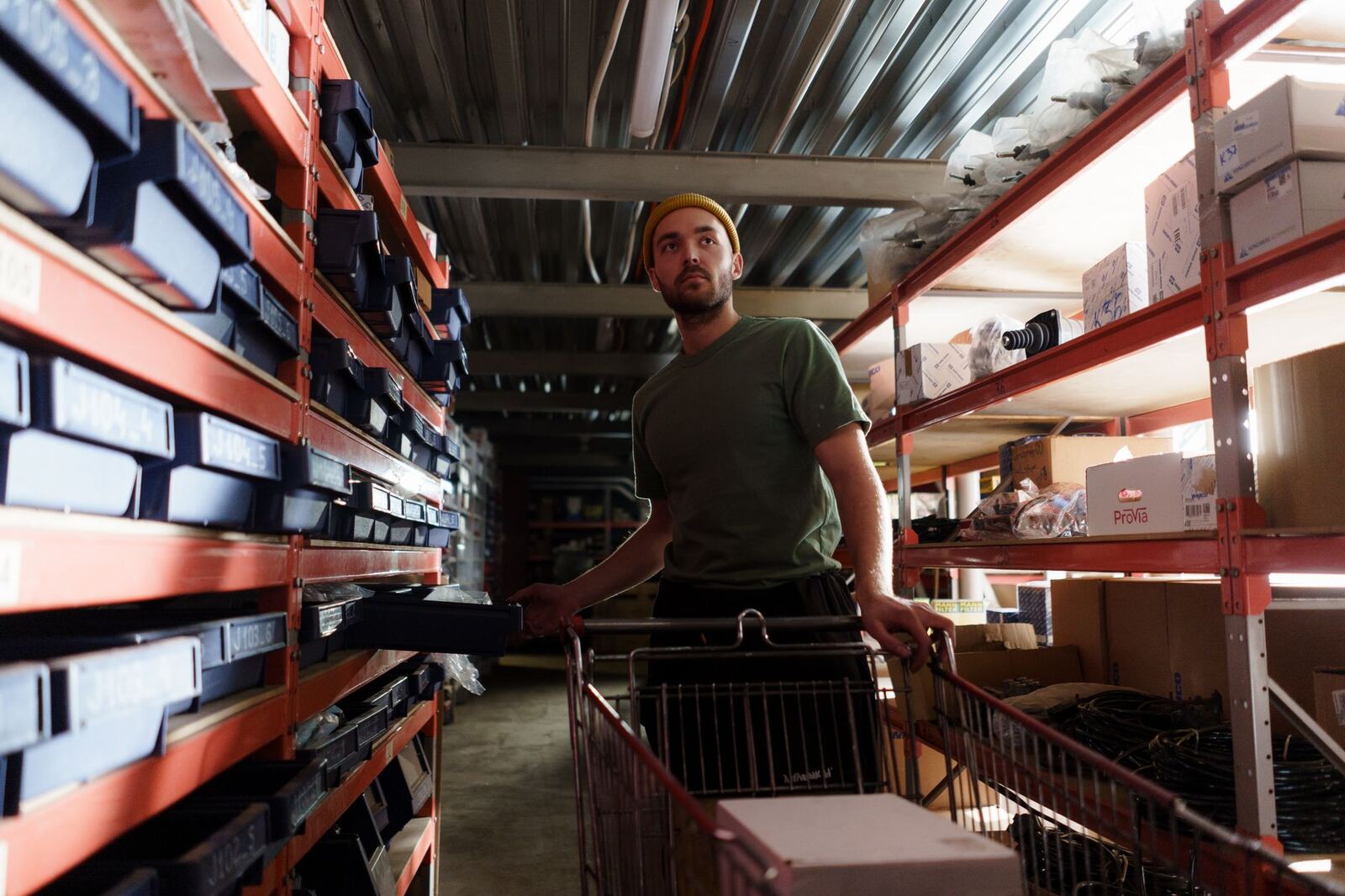
Blanks are the biggest line in most print shop costs and the easiest place to trap cash. The stockroom that feels like preparedness is often several months of profit sitting in cardboard.
What deserves shelf space
Three tests. A style earns stock if it passes at least two:
- You reorder it monthly or more. Predictable demand is what makes a par level meaningful.
- The lead time hurts. If a stockout costs you a job because the supplier takes ten days, holding is buying reliability.
- It is not at risk of discontinuation. Fashion colours and seasonal ranges are the worst things to hold.
Everything else is ordered per job. Your supplier is a better warehouse than you are.
Setting the par level
par level = (average weekly usage x lead time in weeks) + safety buffer
The safety buffer is where judgement lives. A rough rule: half a lead time's usage for steady lines, a full lead time's usage for lines with lumpy demand or an unreliable supplier.
| Item | Weekly usage | Lead time | Buffer | Par |
|---|---|---|---|---|
| Black tee, L | 60 | 1 week | 30 | 90 |
| Black tee, XS | 4 | 1 week | 4 | 8 |
| Navy hoodie, M | 12 | 2 weeks | 12 | 36 |
| Fashion colour tee | 3 | 2 weeks | n/a | Order per job |
Note the XS line. Holding the same depth across a size curve is the most common inventory mistake in apparel: you end up with the extremes on the shelf forever and the middle always out.
Count the middle, not everything
Full stocktakes are painful, so they get skipped, so the numbers drift, so nobody trusts them, so nobody uses them. Cycle counting fixes this: count a small slice weekly, so every fast-moving line gets counted often and the slow ones eventually. Ten minutes a week beats a lost Saturday twice a year.
The three numbers to watch
- Stockouts that cost a job. The only stockout metric that matters.
- Weeks of cover on your top ten lines. Rising cover means cash quietly accumulating on shelves.
- Write-offs. Discontinued, faded, mildewed or simply forgotten. If it is not near zero, you are holding the wrong things.
Order against real demand, not the feeling of being busy
The reorder trigger should come off actual committed orders plus par levels, not off a walk round the stockroom. That means knowing what is committed to jobs already in the system and not yet pulled, which is exactly the number a walk round cannot tell you.
Printer's Friend tracks SKU-level stock with cycle counts, holds a par level per SKU, and suggests purchase orders from committed orders plus par shortfall so you are ordering against demand rather than vibes. Supplier catalogues sync where a live feed exists and import from CSV where it does not, so a quote can check stock before you promise a date.
The safety buffer, sized by variability
A safety buffer is not a feeling, it is a function of how unpredictable two things are: your usage and your supplier. Two lines with identical average usage need very different buffers if one is a steady club order and the other is lumpy retail demand.
| Situation | Buffer as weeks of usage |
|---|---|
| Steady usage, reliable supplier, short lead time | 0.5 to 1 |
| Steady usage, occasionally late supplier | 1 to 2 |
| Lumpy usage, reliable supplier | 2 to 3 |
| Lumpy usage, unreliable supplier or long lead time | 3 to 4, or do not hold it at all |
That last row is important. Some lines should not be stocked, they should be quoted with an honest lead time. Holding four weeks of a slow, unpredictable line is how a stockroom quietly becomes the largest asset in a business that has no cash.
Cost the stockout, not just the stock
The reason par levels get set too low is that holding cost is visible and stockout cost is not. A stockout on a job in production costs rush freight, a resequenced press day, sometimes a late delivery and a credit, and occasionally the account.
A rough comparison for one line, over a year:
- Holding cost. Value on the shelf times roughly 20 to 25 percent, covering cash, space, obsolescence and shrinkage.
- Stockout cost. Number of stockouts times rush freight plus disrupted press time plus the probability of a late delivery penalty.
Run that on your top ten lines and the answer is usually that your fast movers are under-stocked and your slow movers are over-stocked, which is the standard failure of a stockroom managed by memory.
Let the system suggest the order
Reorder points are arithmetic, and arithmetic is what software is for. What matters is that the suggestion comes from real consumption: stock consumed when jobs run, not stock adjusted when someone notices a gap.
That requires the stock ledger and the production system to be the same system. When a quote is accepted the stock is reserved, when the job runs it is consumed, and the reorder point fires against real committed demand rather than a monthly guess. Printer's Friend does exactly that, with suggested purchase orders generated from your own velocity, a purchase order you can email to the supplier in a click, and receiving that credits the ledger so the next suggestion is right.
The three habits that keep it honest
Count the middle regularly. Full stocktakes are rare and wrong; rolling cycle counts on your fastest lines are frequent and right.
Review par levels quarterly. Usage changes with your customer mix. A par level set eighteen months ago is describing a business you no longer run.
Kill a line rather than nurse it. If it has not moved in two quarters, it is not stock, it is furniture. Clear it and take the shelf space back for something that turns.
Related: pricing screen print treats blanks as a cost line, and managing rush season is largely an inventory problem in disguise.